One of the best parts of spending time at Innovation Depot is getting a front-row seat to the kind of work that quietly changes lives. In this Innovation Depot Founder Story: Equip’s Mission to Empower Independence is a perfect example of how startups can have a meaningful impact. When I sat down with Trent Kocurek, I expected to learn what Equip does at a high level. What I walked away with was something better: a story about noticing a real gap, caring enough to do something about it, and building a product that helps people with support needs gain more independence—one routine, one plan, one small win at a time.
So… what is Equip?
I started with the obvious question: if someone’s never heard of Equip, how do you explain it?
Trent put it simply: Equip is a software platform built for organizations that support individuals who need help with independent living skills and employment skills. These organizations might run transition programs, workforce development programs, or employment services. Equip helps them create person-centered plans, track progress over time, and focus on outcomes—so the people they serve can build more independence and thrive in their communities.
The moment Trent knew this needed to exist
Trent didn’t start in this space. Back in 2021, he was running a different company (a software product development and design firm) and navigating the post-COVID shift to remote work. At the same time, he was feeling the pressure of a talent market where expectations were rising fast—bigger salaries, fewer hours, constant churn.
Then something happened that changed the direction of his career.
One morning, his wife came across a Facebook post about a young man from Trent’s hometown of Cullman, Alabama who had been accepted into the EAGLES Program at Auburn University. She asked him a simple question: “Have you ever heard of the EAGLES program?”
Trent hadn’t. So he clicked the link.
And what he saw put two worlds side-by-side:
- people with every opportunity who still wanted to do less and demand more
- and people with the same wants, needs, and dreams as everyone else… who just needed the right support to live and work more independently
That contrast stuck.
He scrolled to the bottom of the page, found the first email address he could, and reached out. That first conversation led to another, and eventually to the early relationships that helped shape Equip. The next year, Trent sold his previous company and went all-in on Equip in September 2023.
Before Equip: binders, spreadsheets, and “hope it doesn’t get lost”
To understand why Equip matters, you have to understand what the process looked like before it existed.
Most of Equip’s customers support individuals with disabilities—often intellectual and developmental disabilities. And Trent kept hearing the same thing from program leaders: the tools weren’t built for their world.
One program leader told him they kept critical information in physical binders—emergency contacts, allergies, medical lists. Schedules lived in shared spreadsheets. Each person had their own tab. Staff would print the tab, take a photo of it, and save it on a phone. If anything changed, they’d delete the photo and repeat the process.
Trent’s reaction was basically: this cannot be real.
But then he talked to other programs… and they were doing the exact same thing.
He also saw a bigger pattern: systems focused on documenting services (“we did the thing”) rather than tracking outcomes (“did it help?”). Add in high turnover and knowledge living in people’s heads, and it’s easy for progress—and important context—to disappear when a staff member leaves.
Equip was created to replace that chaos with something clear, consistent, and actually built for the people doing the work.
What makes it “click” in a demo
When I asked Trent what he shows someone to help them understand Equip fast, he broke it into two parts:
1) A streamlined intake-to-plan flow
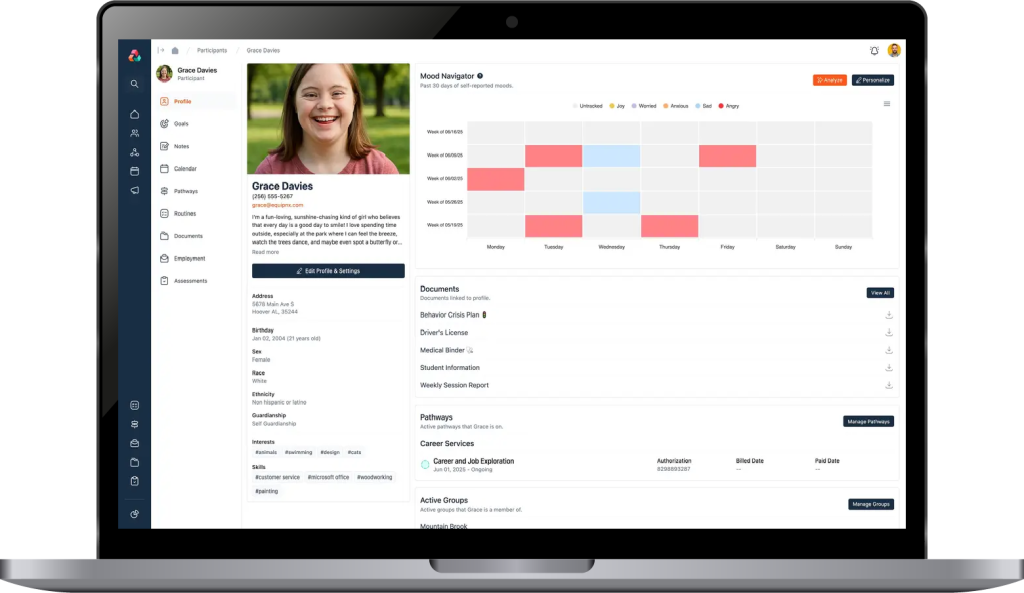
Equip takes an individual from referral/intake all the way to a person-centered plan—without the stacks of forms and disconnected steps. The platform helps capture the details that matter (needs, goals, preferences), then turns that into trackable goals and routines that stay with the person.
2) Progress tracking that’s about outcomes, not activity
Equip makes it possible to create tailored assessments that reflect what each individual is working toward. It’s less “we checked a box today,” and more “here’s the progress over time.” Trent also shared how AI is built into Equip to organize information and highlight next steps—so staff can focus their energy on the human interactions that drive real progress.
The Equip Card: support that goes beyond the four walls
One feature that stood out to me when browsing their site was the Equip Card, and I asked Trent to explain it.
He said a lot of the biggest challenges aren’t happening in a classroom or program setting—they’re happening out in the real world: grocery stores, workplaces, community spaces, and even traffic stops.
Equip is designed to support areas like time management, executive functioning, and emotional regulation—because those are often the difference between someone participating independently and feeling overwhelmed.
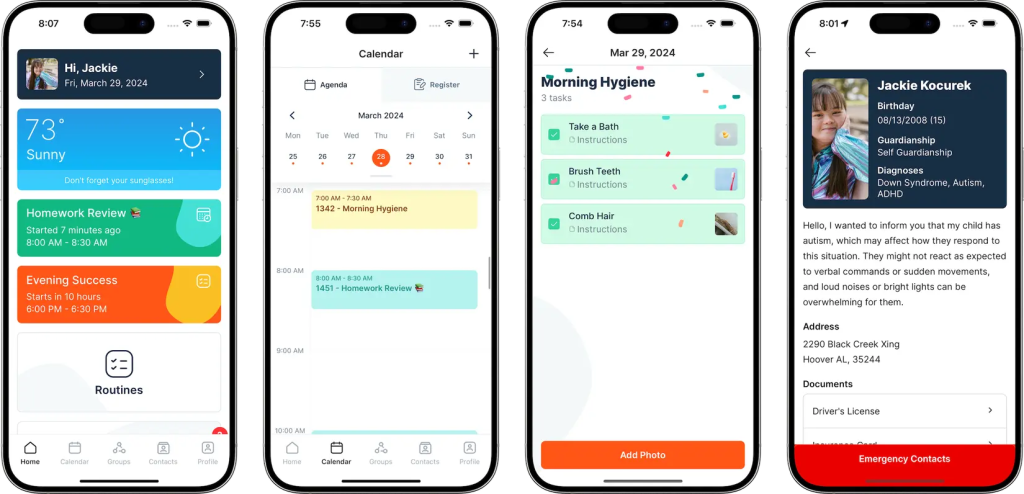
The Equip Card lives inside their mobile app (what they call the “Independence Companion”) and can be pulled up quickly if someone needs help communicating in a stressful moment—like being pulled over.
It shows a photo, basic info, and a customizable message like:
“I have autism. I don’t like loud noises. I don’t like to be touched. I’m not resisting. Please be patient with me.”
It can also include quick access to documents (license, insurance) and an emergency button to contact support people and share location. Trent’s goal with the card is simple: give people a safer, clearer way to communicate when the moment is tense and misunderstandings can happen fast.
A story that stuck with me
To wrap up, I asked Trent for an anonymous before-and-after story—something that shows Equip’s impact in real life.
He shared one about a 26-year-old who struggled with routines: hygiene, taking medication, task focus, and emotional regulation. Her family enabled an optional feature called “Mood Navigator,” which lets the person build a personalized coping plan—step-by-step actions like watching a specific YouTube video, listening to a playlist, or calling a parent when they feel overwhelmed.
They also set up routines with prompts and reminders for daily tasks.
The “before” was a lot of stress and constant hands-on support. The “after” was something the family didn’t expect: the grandmother—who had never been comfortable keeping her overnight—finally could. First a night. Then a weekend. Eventually she was asking for more time together.
For the parents, it meant a breath of relief and a chance to step out for a date night.
For the grandmother, it meant more time with her granddaughter.
And for the granddaughter, it meant something even bigger: dignity. Ownership. A sense that “this is mine.”
Trent said it well: sometimes technology feels less like a parent’s instructions, and more like an empowering tool someone can choose to follow.
Who Equip is built for right now
Equip’s best-fit customers are organizations that support individuals through daily, structured services—especially employment and transition programs. Trent mentioned nonprofits and groups like United Ability, Higher Education Programs like the EAGLES, and even state led initiatives to get people back to work
If an organization cares about:
- reducing administrative chaos
- tracking real progress (not just documenting tasks)
- improving outcomes to support funding and accreditation
- empowering the individual, not just managing the process
…then Equip is built for them.
Innovation Depot helped Equip scale what’s working
Behind a lot of founder success stories, there’s usually a quiet “yes” from the community around them—someone who helped remove friction at the exact right time. For Trent, that support showed up through both The Network and grant funding at Innovation Depot.
As he put it, having those resources “allowed us to experiment more” at a critical stage—surrounded by people who could help Equip learn, position itself well, and build faster.
Through The Network, Trent said Equip was able to get help tightening their website messaging and copy—making it easier for the right customers to quickly understand what Equip does and why it matters. Then, with grant funding, Equip brought in development support to build key functionality—specifically a role-based authentication system—that made the platform ready for bigger, more complex organizations.
That wasn’t just a technical upgrade. Trent shared that this work helped Equip unlock enterprise customers and led to at least $200,000 in new customer revenue—and potentially far more—because they could meet the requirements of larger teams. Without that support, he said, they would have moved slower, hired later, and may have missed opportunities to serve bigger customers that ultimately allow Equip to scale its impact.
When you support the builder, you’re also supporting the real people and families their product touches every day.
Why this matters at Innovation Depot
This is exactly the kind of story we love telling at Innovation Depot. Not because it’s flashy—but because it’s meaningful.
Trent and the team at Equip are building something that makes daily life a little easier for families, support teams, and—most importantly—the individuals working toward more independence.
And the best part? The wins aren’t theoretical. They look like a night at grandma’s house. A calmer moment in the community. A routine that finally clicks. The kind of progress that feels small until you realize it changes everything.
Get the monthly newsletter
Learn about upcoming events and the latest news in tech. Delivered to your inbox weekly.