Month: September 2026

Introducing Voltage 13!

Innovation Depot is excited to welcome Voltage Cohort 13 — a new group of aspiring founders ready to test ideas, challenge assumptions, and start building.

Voltage is Innovation Depot’s intensive five-week, idea-stage program designed to help early founders move from “What if?” to “What’s next?” Through hands-on work, expert guidance, and a community of peers, participants learn how to validate their ideas, better understand their customers, and determine what it will take to turn an early concept into a real opportunity.

In partnership with Harmony Venture Labs, Cohort 13 will spend the next several weeks researching, testing, refining, and building alongside one another. Some ideas will evolve. Some assumptions will change. And every participant will leave with a clearer understanding of what it takes to move forward.

That process is what Voltage is all about: giving founders a place to start, the tools to learn quickly, and a community to build alongside.

Meet Voltage Cohort 13

Aditya Singh

Aquil Abdur-Rasheed

Armand Green

Ashley Rose Rhea

Benjy Thomas

Carey Fountain

Carla Sims

Caroline Ford

Chase Vines

Clay Haley

Emmett Davis

Gibril Davies

Kiersten Little

Michael Raspberry

Shubhangi Singh

Todd Lind


We’re excited to follow their progress over the next five weeks and see what takes shape. For many founders, Voltage is the first step in a much longer journey — and we’re proud to be there at the beginning.

Welcome to Voltage 13. Let’s build.

About Innovation Depot

Innovation Depot is a 501(c)(3) nonprofit tech and entrepreneurial support organization housed in a 140,000-square-foot facility in downtown Birmingham. As the largest tech hub in the Southeast, Innovation Depot supports founders at every stage — from idea validation to startup growth — through structured programs, expert resources, workspace, community, and access to capital.

To learn more about Voltage, visit innovationdepot.org/program/voltage.

Think Like an Entertainer: Raj Nathan on Building a Better Pitch

Founders spend a lot of time thinking about what to say in a pitch — but few think like an entertainer when they say it.

Raj Nathan challenged our Capital Readiness cohort to think just as hard about how it feels to hear it.

During his recent session at Innovation Depot, Raj, founder of Startup Hypeman, encouraged founders to stop thinking only like entrepreneurs when they pitch and start thinking like entertainers.

Not because every founder needs to become a performer.

But because entertainers are constantly thinking about one thing: the audience.

“How do I move my audience? How do I make them feel something?”


Raj compared a great pitch to a concert setlist.

When a band takes the stage, they don’t play every song they’ve ever written just because they can. They choose what matters. They think carefully about the opener, where the energy shifts, what comes next and how they want the audience to feel when the show ends.

A founder should approach a pitch the same way.

You know every feature, customer conversation, statistic and product decision behind your company. Your audience doesn’t need all of it.

They need the highlights.

As Raj put it, founders need to “play the hits.”

That means choosing the pieces of your company’s story that will make someone understand the problem, connect with it and want to keep listening.

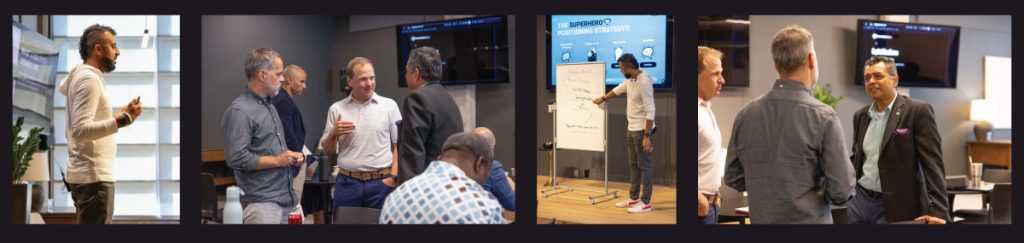
Capital Readiness Collage

And entertainment doesn’t mean being loud, funny or charismatic.

One founder in the room pushed back on the idea, noting that not everyone naturally has a big personality. Raj’s response was important: the goal isn’t to become an entertainer. It’s to think like one.

Speak with intention. Know your audience. Care about how the story lands. Give people a reason not to check their phone.

That same thinking applies to delivery.

Raj pointed out that founders can easily develop “pitch fatigue.” After explaining your company five or six times at an event, it’s tempting to rush through the next conversation.

But for the person standing in front of you, it may be the first time they’ve ever heard your story.

They deserve the full version.

A strong pitch also doesn’t have to explain everything. Its job is to make someone curious enough to ask the next question, schedule the next meeting or lean in and say, “Tell me more.”

That’s what makes pitching less about presenting information and more about creating an experience.

For founders preparing to raise capital, the takeaway was simple:

Don’t just know your story. Curate it. Practice it. Deliver it with purpose.

Think like an entertainer; give your audience a reason to stay for the next song.