Category: Featured Founders

Founder Focus: Jim Cavale Is Building the Players Association College Athletes Have Never Had

College athletics is changing faster than ever, and Jim Cavale believes athletes deserve a voice in shaping what comes next.

For Jim Cavale, Founder of Athletes.org, that conversation goes far beyond the pitch.

Athletes.org is building something college sports has never truly had before: a players association for college athletes. In professional sports, players associations help athletes have a voice in the rules, standards, and business structures that define their leagues. Jim believes college athletes need the same thing now more than ever.

“Athletes.org is the players association for college athletes,” Jim said. “We’re building it to represent athletes in setting the rules for college athletics.”

Today, Athletes.org has signed up more than 5,000 active college athletes as members. Membership is currently free, with the long-term vision of creating an organization that can represent athletes collectively while also opening the door to group licensing opportunities around things like video games, trading cards, and other uses of athletes’ name, image, and likeness.

At a time when college sports is changing quickly, Jim sees Athletes.org as a way to bring structure, representation, and clarity to a system that has become increasingly complicated.

Seeing the Game Change Before Everyone Else

Jim’s path to Athletes.org started with a front-row seat to one of the biggest shifts in college athletics: NIL.

Through his previous company, INFLCR, which was acquired by Teamworks, Jim helped build software for college athletics departments. Part of that work involved NIL technology that processed transactions between athletes, donor collectives, and brands.

What he saw in the data told a bigger story.

Jim realized that much of what was being called NIL was functioning more like pay-for-play. The system was moving fast, but without enough structure around it. Schools were competing to outspend one another. Athletes were navigating deals, expectations, and compensation without the same kind of collective voice professional athletes have had for decades.

Jim saw the writing on the wall.

College sports needed transfer rules. It needed academic standards. It needed health and safety standards. It needed eligibility rules. It needed structure around compensation.

Most importantly, Jim believed athletes needed a seat at the table before those rules were written.

That belief became the foundation for Athletes.org.

The Founder Behind the Mission

Athletes.org is not Jim’s first company. He has built across industries, from NextSpex to Iron Tribe Fitness to INFLCR, and each experience taught him something that still shapes the way he builds today.

The biggest lesson?

“You can’t build anything great without great people.”

Jim says the more a founder tries to do alone, the less scalable the company becomes. Great founders have to understand their own weaknesses, bring in people who complement them, and build teams that make the entire company stronger.

Each company also gave him a different kind of lesson.

At NextSpex, Jim learned the value of recurring revenue the hard way. After building a strong subscription model, the company shifted toward an advertising and freemium model. Looking back, he says that was a mistake.

“Don’t ever give up recurring revenue,” he said.

At Iron Tribe Fitness, Jim learned the power of community and the importance of clearly defining your audience. The company grew into nearly 50 gyms across the Southeast and became what many people considered a “third place” — not home, not work, but a place where people belonged.

But Jim also saw how important focused marketing can be. Trying to reach everyone can water down the message. Building for a specific audience can create deeper traction.

At INFLCR, Jim learned what it takes to lead inside a growing company. After the acquisition by Teamworks, he stayed on board and learned that as companies grow, founders have to become internal salespeople. Even as a CEO, it is not enough to have the idea. You have to bring people along, help them understand the vision, and make them feel ownership in what comes next.

Building in a Market That Changes in Real Time

College athletics is changing quickly. NIL, transfer rules, employment conversations, media rights, and the role of athletes are all shifting at once.

For founders building in industries like that, Jim’s advice is simple: become a student of the game.

That means staying curious, doing daily research, reading what is happening in the market, paying attention to regulatory changes, watching the competitive landscape, and surrounding yourself with advisors who can help you see around corners.

Jim also sees AI as a tool that can help founders keep up. By feeding AI the right information from inside a business and pairing it with outside market intel, founders can build daily briefs that help them understand what is changing and where things may be headed.

“You should wake up not just thinking about the present, but thinking about where this is going,” Jim said.

For Jim, the danger is getting stuck in the past. He points to examples like Blockbuster, Kodak, and the record labels that fought disruption instead of building what came next.

The lesson for founders is clear: the market is going to move. The rules are going to change. The companies that win are the ones paying attention before the shift becomes obvious.

Why It Matters

Athletes.org is tackling a massive challenge: helping college athletes organize, understand their value, and have a voice in the future of college sports.

It is a mission built for a changing market, but it is also a founder story about timing, pattern recognition, and conviction.

Jim saw a system changing in real time. He understood where the pressure points were. And instead of waiting for someone else to build the solution, he stepped in.

That is the kind of founder story we love at Innovation Depot.

Because whether you are building in sports, software, healthcare, finance, or any other fast-moving industry, the work is the same: study the market, build the right team, listen closely, and create the thing the future is going to need.

As Jim put it, founders have to stay in front of what is coming.

For any entrepreneur building in a fast-changing market, that may be the real lesson: study the shifts, surround yourself with the right people, and build toward the future before the rest of the market catches up.

Meet Trent Kocurek of Equip: Building Tools That Empower Independence

One of the best parts of spending time at Innovation Depot is getting a front-row seat to the kind of work that quietly changes lives. In this Innovation Depot Founder Story: Equip’s Mission to Empower Independence is a perfect example of how startups can have a meaningful impact. When I sat down with Trent Kocurek, I expected to learn what Equip does at a high level. What I walked away with was something better: a story about noticing a real gap, caring enough to do something about it, and building a product that helps people with support needs gain more independence—one routine, one plan, one small win at a time.


So… what is Equip?

I started with the obvious question: if someone’s never heard of Equip, how do you explain it?

Trent put it simply: Equip is a software platform built for organizations that support individuals who need help with independent living skills and employment skills. These organizations might run transition programs, workforce development programs, or employment services. Equip helps them create person-centered plans, track progress over time, and focus on outcomes—so the people they serve can build more independence and thrive in their communities.


The moment Trent knew this needed to exist

Trent didn’t start in this space. Back in 2021, he was running a different company (a software product development and design firm) and navigating the post-COVID shift to remote work. At the same time, he was feeling the pressure of a talent market where expectations were rising fast—bigger salaries, fewer hours, constant churn.

Then something happened that changed the direction of his career.

One morning, his wife came across a Facebook post about a young man from Trent’s hometown of Cullman, Alabama who had been accepted into the EAGLES Program at Auburn University. She asked him a simple question: “Have you ever heard of the EAGLES program?”

Trent hadn’t. So he clicked the link.

And what he saw put two worlds side-by-side:

  • people with every opportunity who still wanted to do less and demand more
  • and people with the same wants, needs, and dreams as everyone else… who just needed the right support to live and work more independently

That contrast stuck.

He scrolled to the bottom of the page, found the first email address he could, and reached out. That first conversation led to another, and eventually to the early relationships that helped shape Equip. The next year, Trent sold his previous company and went all-in on Equip in September 2023.


Before Equip: binders, spreadsheets, and “hope it doesn’t get lost”

To understand why Equip matters, you have to understand what the process looked like before it existed.

Most of Equip’s customers support individuals with disabilities—often intellectual and developmental disabilities. And Trent kept hearing the same thing from program leaders: the tools weren’t built for their world.

One program leader told him they kept critical information in physical binders—emergency contacts, allergies, medical lists. Schedules lived in shared spreadsheets. Each person had their own tab. Staff would print the tab, take a photo of it, and save it on a phone. If anything changed, they’d delete the photo and repeat the process.

Trent’s reaction was basically: this cannot be real.

But then he talked to other programs… and they were doing the exact same thing.

He also saw a bigger pattern: systems focused on documenting services (“we did the thing”) rather than tracking outcomes (“did it help?”). Add in high turnover and knowledge living in people’s heads, and it’s easy for progress—and important context—to disappear when a staff member leaves.

Equip was created to replace that chaos with something clear, consistent, and actually built for the people doing the work.

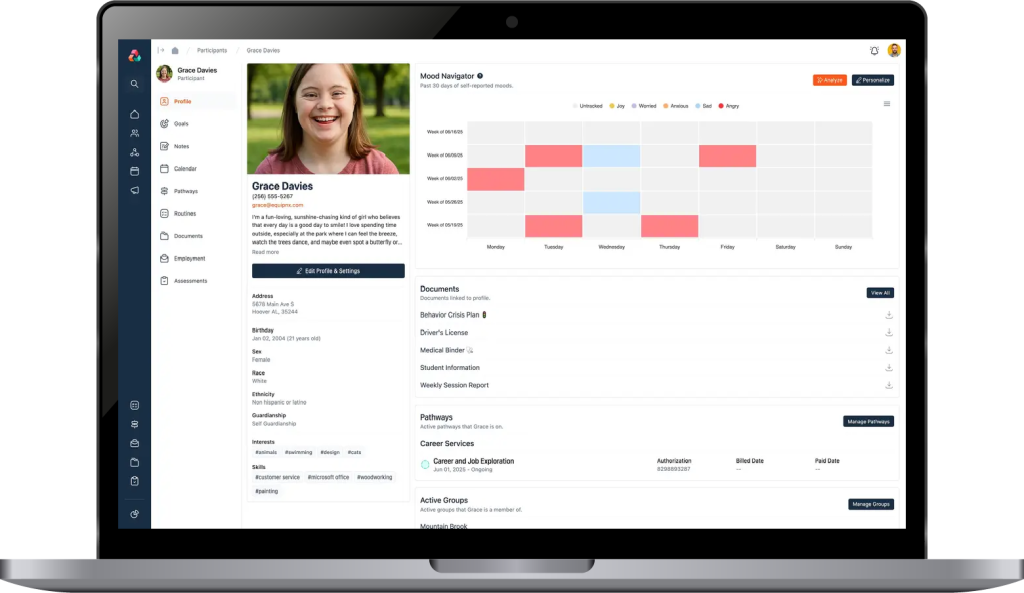
Equip Screenshot


What makes it “click” in a demo

When I asked Trent what he shows someone to help them understand Equip fast, he broke it into two parts:

1) A streamlined intake-to-plan flow
Equip takes an individual from referral/intake all the way to a person-centered plan—without the stacks of forms and disconnected steps. The platform helps capture the details that matter (needs, goals, preferences), then turns that into trackable goals and routines that stay with the person.

2) Progress tracking that’s about outcomes, not activity
Equip makes it possible to create tailored assessments that reflect what each individual is working toward. It’s less “we checked a box today,” and more “here’s the progress over time.” Trent also shared how AI is built into Equip to organize information and highlight next steps—so staff can focus their energy on the human interactions that drive real progress.


Equip


The Equip Card: support that goes beyond the four walls

One feature that stood out to me when browsing their site was the Equip Card, and I asked Trent to explain it.

He said a lot of the biggest challenges aren’t happening in a classroom or program setting—they’re happening out in the real world: grocery stores, workplaces, community spaces, and even traffic stops.

Equip is designed to support areas like time management, executive functioning, and emotional regulation—because those are often the difference between someone participating independently and feeling overwhelmed.

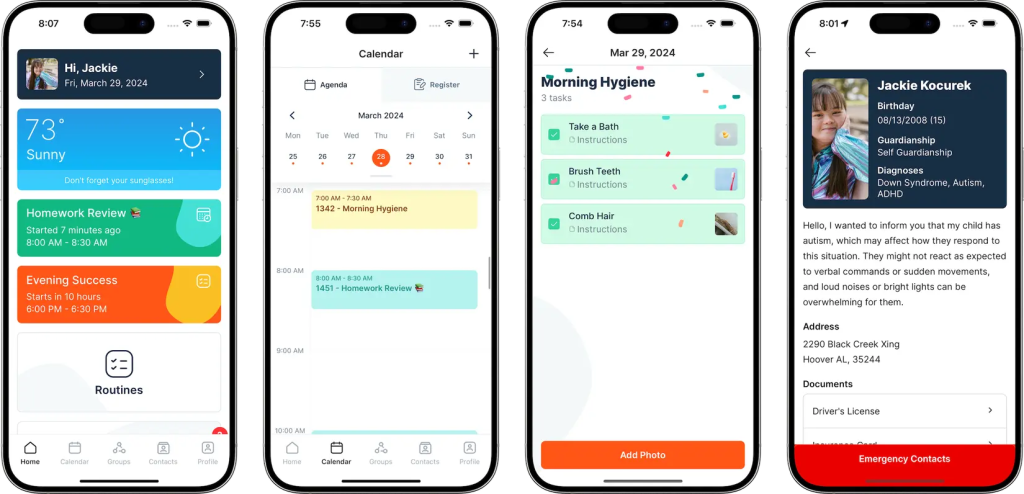
The Equip Card lives inside their mobile app (what they call the “Independence Companion”) and can be pulled up quickly if someone needs help communicating in a stressful moment—like being pulled over.

It shows a photo, basic info, and a customizable message like:
“I have autism. I don’t like loud noises. I don’t like to be touched. I’m not resisting. Please be patient with me.”

It can also include quick access to documents (license, insurance) and an emergency button to contact support people and share location. Trent’s goal with the card is simple: give people a safer, clearer way to communicate when the moment is tense and misunderstandings can happen fast.


A story that stuck with me

To wrap up, I asked Trent for an anonymous before-and-after story—something that shows Equip’s impact in real life.

He shared one about a 26-year-old who struggled with routines: hygiene, taking medication, task focus, and emotional regulation. Her family enabled an optional feature called “Mood Navigator,” which lets the person build a personalized coping plan—step-by-step actions like watching a specific YouTube video, listening to a playlist, or calling a parent when they feel overwhelmed.

They also set up routines with prompts and reminders for daily tasks.

The “before” was a lot of stress and constant hands-on support. The “after” was something the family didn’t expect: the grandmother—who had never been comfortable keeping her overnight—finally could. First a night. Then a weekend. Eventually she was asking for more time together.

For the parents, it meant a breath of relief and a chance to step out for a date night.
For the grandmother, it meant more time with her granddaughter.
And for the granddaughter, it meant something even bigger: dignity. Ownership. A sense that “this is mine.”

Trent said it well: sometimes technology feels less like a parent’s instructions, and more like an empowering tool someone can choose to follow.

Who Equip is built for right now


Equip’s best-fit customers are organizations that support individuals through daily, structured services—especially employment and transition programs. Trent mentioned nonprofits and groups like United Ability, Higher Education Programs like the EAGLES, and even state led initiatives to get people back to work

If an organization cares about:

  • reducing administrative chaos
  • tracking real progress (not just documenting tasks)
  • improving outcomes to support funding and accreditation
  • empowering the individual, not just managing the process

…then Equip is built for them.


Innovation Depot helped Equip scale what’s working

Behind a lot of founder success stories, there’s usually a quiet “yes” from the community around them—someone who helped remove friction at the exact right time. For Trent, that support showed up through both The Network and grant funding at Innovation Depot.

As he put it, having those resources “allowed us to experiment more” at a critical stage—surrounded by people who could help Equip learn, position itself well, and build faster.

Through The Network, Trent said Equip was able to get help tightening their website messaging and copy—making it easier for the right customers to quickly understand what Equip does and why it matters. Then, with grant funding, Equip brought in development support to build key functionality—specifically a role-based authentication system—that made the platform ready for bigger, more complex organizations.

That wasn’t just a technical upgrade. Trent shared that this work helped Equip unlock enterprise customers and led to at least $200,000 in new customer revenue—and potentially far more—because they could meet the requirements of larger teams. Without that support, he said, they would have moved slower, hired later, and may have missed opportunities to serve bigger customers that ultimately allow Equip to scale its impact.

When you support the builder, you’re also supporting the real people and families their product touches every day.


Why this matters at Innovation Depot

This is exactly the kind of story we love telling at Innovation Depot. Not because it’s flashy—but because it’s meaningful.

Trent and the team at Equip are building something that makes daily life a little easier for families, support teams, and—most importantly—the individuals working toward more independence.

And the best part? The wins aren’t theoretical. They look like a night at grandma’s house. A calmer moment in the community. A routine that finally clicks. The kind of progress that feels small until you realize it changes everything.


From Golf Course to Game Day: How Wunderfan’s Blake Patterson Is Rewarding the Fans Who Never Miss a Moment

Blake Patterson, co-founder of Wunderfan, wasn’t expecting a celebrity product moment at Super Bowl week.

But in the middle of the chaos—events all over the city, athletes and entertainers everywhere—Blake felt someone lock eyes with him in the crowd.

It was Frank Caliendo, a longtime sports-comedy favorite and impressionist.

A second later, Caliendo stopped him.

“Are you Wunderfan?”

Then he pulled out his phone and showed Blake the app.

“Man, I got your app. I used this last night.”

For a company built around sports fandom, it’s hard to imagine better validation than that: someone with a massive platform not just recognizing the brand, but actively using the product.

And like most “overnight” moments, it took years of building to get there.


The Quick Version: What Is Wunderfan?

Wunderfan is a fan-first loyalty platform that turns sports engagement into rewards.

Fans earn Wunder Coin by watching games, attending events, interacting with content, making picks, and purchasing tickets—then use those rewards inside the app, including toward future tickets.

The goal is to make fandom more rewarding while helping teams and brands drive deeper, longer-lasting engagement.

Wunderfan


The “This Could Be Real” Moment

Before Wunderfan, the team built a sister app called Wunderpar, originally as a “hobby.” Early on, Blake had a formative trip to Las Vegas where he met the founder of CBS SportsLine (later CBSSports.com). He created a video concept—Michael Jordan vs. Tom Brady: who’s the GOAT?—and it performed exceptionally well.

That’s when the feedback landed:

Sports wasn’t just an audience. It was their audience.

Instead of building a tech product and hoping it finds a home, the direction became clearer: build for the category that already has obsession baked in.


Wunderfan grew out of an earlier concept called Wunderpar, a golf-based rewards app where users earned points simply for playing.

The team layered in drops, competition, and real-time leaderboards, and when brands like Callaway showed interest, it confirmed they were onto something.

But golf is still niche—so they took the same “reward fans for what they already do” model and expanded it into a much larger arena: mainstream sports.

Inspired by the challenge teams face not just filling stadiums but keeping fans engaged, the idea evolved into Wunderfan—built for football and beyond.


Super Bowl Week: “Beyond Surreal”

Wunderfan was invited to Super Bowl week through connections tied to the NFL and a major podcast, and the experience put the company directly in front of the sports world’s biggest names.

Blake describes it as surreal: meeting and talking with A-listers, having real conversations instead of quick drive-by interactions.

But the Caliendo moment still stands out because it wasn’t networking—it was proof of usage.

People weren’t just saying, “cool idea.” They were saying, “I’m already in it.”


The Next Six Months: Growth Mode

Blake says the company is pushing toward being an “enterprise” app, improving the experience with more gamification and a homepage built for stronger retention.

Up until now, much of the growth has been organic. The next phase looks different:

  • Paid advertising

  • Partnerships

  • Scaling with dedicated teams

  • Preparing for a Series A


The New “Aha”: Tickets Without Fees

Right now, the biggest momentum driver is Wunderfan’s ticket marketplace—an international inventory built into the app.

Blake says they have $200M worth of tickets available at any given time, covering sports, concerts, and other live events. The marketplace is location-aware, so it shows relevant events whether you’re in Birmingham or abroad.

The fan benefit is obvious:

  • Apply Wunder Coin to lower the ticket cost

  • Earn rewards even if you don’t have Coin yet

  • Avoid the fee shock that hits on the secondary market

Blake says the ticket side is already nearing $10,000 per day in revenue and has captured attention from colleges and pro teams—because their job is simple: get people in seats, then deliver a great experience.

Wunderfan helps with the first part and improves the second by making fans feel rewarded for showing up.


Building in Birmingham, Growing Everywhere

Wunderfan may be building for a global sports audience, but it’s rooted in Birmingham—and Blake says Innovation Depot has been a big part of that. “My thesis is team, team, team,” he told us. “And here at Innovation Depot, it really feels like we’re a part of a team.” For a founder, that daily support matters: people around you knowing what you’re building, encouraging it, and helping keep momentum moving.

Blake also points to the advantage of the Innovation Depot name itself—especially with leaders like Brooke and Ritchie, and the track record of wins that have come out of the building. In a city he describes as having strong private capital and a growing “yes” mentality, he believes Birmingham can be “Austin 2.0”—a place where founders prove you can build something worldwide from anywhere. For Wunderfan, that global organization is being built right here.

Meet the Founders Behind Prismm: Building the Vault for Generational Wealth

At Innovation Depot, we believe some of the best startups are born from deeply personal experiences, and the story behind Prismm is no exception.

In this episode of Mile-A-Minute, we walk and talk with sisters Martha Underwood and Shella Sylla, the powerhouse duo behind Prismm, a digital vault designed to simplify one of life’s most complex moments: transferring wealth and information after a loved one passes.

It all started with a scare. When their father fell off a roof during Hurricane Irma and was rushed to the hospital, their mother was left scrambling for critical documents; health directives, insurance details, and more. That moment revealed a massive gap in how families manage and access end-of-life information. Prismm was built to close that gap.

Today, Prismm is changing the game for banks, financial institutions, and wealth advisors by providing a secure, accessible platform to store and transfer essential documents. As Martha says in the interview, “Love for my parents inspired this—and I never want anyone else to feel that helpless in an emergency.”

The best part? This is a true family business. Martha and Shella aren’t just co-founders; they’re sisters. “I get to tell her like it is,” Martha laughs, “and she can’t do anything about it because she’s stuck with me.”

Their mission is simple but powerful: make hard conversations easier and help families plan for the future with confidence.

💬 “Prismm is the vault built for the next generation, powered by the wealth of the last generation.”

Watch the full conversation below to hear more about their story, meet their CTO Chris, and get a behind-the-scenes look at how Prismm is building the future of digital legacy.


Enjoy this video? Be sure to check out our recent chat with Thomas Coiner of SportsFeed too!